Friday, March 11, 2011

Past Productions

BAM is a theatre group in New York that performs many different shows in it's multitude of venues. The theatre was built in 1861 and has been putting on show ever since. In 2010 they put on a performance of As You Like It. The link below takes you to the event page from their website and provides a quick video of an advertisement for their production.
http://www.bam.org/view.aspx?pid=1672

The following link takes you to a youtube short video of an As You Like It. This video is about the Stratford Shakespeare Festival's 2010 production of As You Like It directed by Des McAnuff. It shows their concept of what the play could look like. The second link takes you to the shows page from their actual website.
http://www.youtube.com/watch?v=wXuO8sD6B_c

This link takes you to an older picture of the cast of As You Like It from Westminster College from 1922. This gives a great look at what doing this play in the past may have looked like.
http://content.lib.utah.edu/cdm4/item_viewer.php?CISOROOT=/WC_PhotoCol&CISOPTR=105

Villanova University's graduate theatre department put on As You Like It in their 2009-2010 production season. The link will take you to pictures from their production.

Music for the Show

For the preshow music there should be some classical and fanciful music. More specifically music that can bring the audience to the feeling of both the court and the pastoral in the play. Classical music provides nice background music for them to talk amongst each other while still providing some mood setting for what they are about to watch.
Below are links to some musical pieces that could be great for preshow music.

This is Brahms Symphony No.3 in F Major

This is Holst's song for Saturn from The Planets
http://www.youtube.com/watch?v=Qb79SiZrzvw

This is a link to Waltz of the Flowers

This is Beethoven's 6th Symphony

Space and Set


The look of the wood floor for the court

This production of As You Like It will be performed in the Milo Smith Tower Theatre to allow a more imaginative set and a closer audience/play experience. The seats will be arranged in a thrust style seating. Shakespeare's plays are open to lots of interpretation when it comes to the set. The court and the Forest of Arden will be two very different feels and therefore two very different places.
The court should be darker with harsher lighting. The floor will be a wood floor piece that can be moved on and off stage easily. The wood should be a dark and shiny, expensive looking floor. The set pieces should be able to be carried on and off easily by the cast or "servants" in the court. For example a bench for scenes with Celia and Rosalind, and a wrestling area for the wrestling scene. Each new place for the scenes should have a specific piece of furniture that can be related to that scene.

The feel/look of the Forest of Arden

Once the scenes change to the Forest of Arden the wood floor piece will come off and a new floor piece will come on. The piece should have a wooden or dirt walkway that continues from back to front. The parts that have no walkway will have grass and trees, creating a "forest" inside of the theatre. The walkways should be a lighter brown color and look dirty and worn. Posisibly even instead of a wooden path a dirt trail.
The following link brings you to a website that can help get the wood finish for the court floor that is what we are looking for without the expense of buying that wood. There is a video that shows how to get the finished product look we want by painting. This would be a cost effective way of getting the look we want but for less.

Costumes in the Pastoral

The pastoral is very different than the court. So the costumes will reflect that. Dictionary.com's definition of pastoral is, "having the simplicity, charm, serenity, or other characteristics generally attributed to rural areas: pastoral scenery; the pastoral life" (dictionary.com, pastoral). This is a great definition to think about when thinking of the costumes for this part of the play. The women's costumes will be much more relaxed than that of the court. The colors will be browns and lighter, brighter colors. There should be lots of pinks, oranges, yellows and browns. Rosalind in the pastoral is dressed up as a man because she is in hiding. So she will need to be in pants, a shirt and a hat. Her pants will be khaki and look slightly dirty with an off white shirt with a burnt orange vest. The hat should be large enough to cover the actress’s hair without dominating her. Celia should be in brown skirt with either gladiator sandals or boots, paired with a light pink shirt. The costumes should have a somewhat country and modern hippie look and feel. The costume should provide the actress with the ability to move freely and whatever way she feels. This should provide a great contrast to the feel of the court.
The men overall in the pastoral should have similar costumes to that of Rosalind's with some slight differences and color changes. The females over all should have similar costumes to Celia. The only difference is that some will be in dresses and colors within the same color scheme. Orlando and Oliver will also wear the "country" attire in this place. Duke Senior will be in similar dress. Since the pastoral is a world that is freer than the court he should not stand out as too much different than others.
At the end of the play there is the wedding scene. Rosalind and Celia's wedding attire should be summer dresses that still fit the mood, setting and color scheme of the pastoral. The character Hymen enters at the end to marry the couples. Since he is the God of marriage it would be nice to give hints of this god-like quality by placing him in a white flowing shirt. However, it should not be so different from the others that he seems out of place.

Sources Cited:

Pastoral; dictionary.com editors; dictionary.com; http://dictionary.reference.com/browse/pastoral

Costumes for the Court

Since As You Like It has two very different settings, city and pastoral, the costumes will reflect the differences between the two settings.
In the city or court the costumes will be very structured and harsh. The garments will be in darker colors. Deep greens and blues with some black accents. They will be very regal, fancy and upper-class.
The women of the court will wear corsets; most specifically for Rosalind and Celia. This will show the harsh, strict structure of the court. By having costumes that are cumbersome and restricting it will allow for a physical restriction of the actresses. Especially when later they go into the pastoral.
The men will wear the same time period court attire. The Duke's would be much greater and regal looking than that of the other men in the court. His clothes will hold a similar quality and look that Celia and Rosalind's costumes hold. Celia and the Duke should be in blue and Rosalind in a green. Celia and Rosalind's dresses should hold similar qualities that tie them together. But the blue ties Celia and the Duke together as father and daughter.
Orlando, Oliver and Le Beau would have similar costumes but would be much less elegant than that of the Duke Frederick’s. Also Orlando's clothes would be much poorer looking than that of Oliver's. His would be more dirty and slightly tattered since Oliver treats him poorly. 
For the wrestling scene Orlando and Charles would be in the same costumes but without their jackets. It would just be the basics of their clothing.
The servants of Oliver and the Duke would wear basic clothes. Nothing too terribly fancy but still done up just enough to show the fact that they work for someone who is better off.
Touchstone, the clown, would be in a more fanticiful outfit. His clothing would be different than that of the others in the court. However, he would still stick to the same color scheme.

The following link is to a video about how to put on a corset. This can help show the dressers and the women wearing corsets how to put one on.
http://www.videojug.com/film/how-to-wear-a-corset

"And All the Men and Women Meerly Players..."

Touchstone:
Touchstone is the jester, or clown, of the play. "Touchstone of As You Like It is probably the clown who has had most attention from critics" (Videbaek, pg 84). Because Touchstone is not the "typical" clown he has been looked at somewhat more than others. Touchstone is an integral part of the play. He comes in with the main character at the beginning in the court and then travels with Rosalind and Celia to the Forest of Arden. Once in the forest it is almost like he has his own subplot. The audience gets to see Touchstone's wit with a shepherd and then trying to woo a shepherdess. "But first and foremost he is a brilliant stage clown, and his duty as such is in serving the interests of the audience" (Videbaek, pg 86). Touchstone's character provides the perfect amount of entertainment in this play. He is a brilliant part.

Dukes (Frederick and Senior):
The two Dukes are interesting characters. At the beginning of the play you find out that Duke Senior has been banished to the Forest of Arden by his brother Duke Frederick. Duke Frederick is Celia's father and Duke Senior is Rosalind's father. Even though Duke Senior was banished Rosalind was allowed to live in the court still with Celia. However, Duke Frederick's anger causes him to still banish those who were true to Duke Senior. Thus, is Orlando and Rosalind banished as well. In the forest you get to see Duke Senior as a loving man who treats his subjects well. He takes in Orlando and Adam and shares his food with them. In the end Duke Senior does gain his power back and Duke Frederick ends up a better man.

Celia:
 In the court Celia is more out spoken than Rosalind is. She seems to be the one who takes control in the court. However, once the play moves to the forest Celia becomes mainly an observer to Rosalind and her antics with Orlando. She usually on speaks when it is just her a Rosalind. Other than that she does not really speak. She plays a very great contrast to that of Rosalind's character.

Jaques:
Jaques is one of the men that stay with Duke Senior in exile in the forest. He is a broody type of character that finds much joy and entertainment in Touchstone. His character also has many talks with Orlando. The one thing Jaques is most known for though is his speech about the life of a person. He relates the life of a man to that of a "player" on stage. "In his description of the seven ages, Jaques provides us with a series of little character sketches, all self-contained, each stage apparently deriving nothing from the age before" (Greer, pg 52). His character's views on the world are on the sad side of the spectrum, yet with his monologue he hits home with the audience about life and creates a memorable experience.


Sources Cited:

The Stage Clown in Shakespeare's Theatre; Bente A. Videbaek; Greenwood Press; Westport; 1996


Shakespeare: A Very Short Introduction; Germaine Greer; Oxford University Press; New York; 2002

Rosalind


Edmonds Community College's Rosalind and Orlando

The character of Rosalind in As You Like It is the second biggest part in Shakespearean plays next to Hamlet and is the largest female role in all of Shakespeare's work. Rosalind in the court and in the pastoral are two very different characters. In the court Rosalind acts very much like a woman "should act" in a court. She speaks less than Celia and really only speaks when Celia and her are alone. She behaves in the way women were expected to.
Once in the pastoral Rosalind's character is dressed as a man and so speaks and acts as one. This allows her to have conversations that a woman of the time would not have. She speaks freely with all of the different characters but most specifically with Orlando, her love interest.
Rosalind's character deals with a multitude of changes throughout the show. Not only does she have to stay in hiding but she also is trying to pursue her love, Orlando, while avoiding a young girl, Phebe from pursuing her. By the end of the show Rosalind's growth is wonderful and different from many female characters of the time. She becomes a self-assured woman who still gets the guy in the end.

Rosalind giving the epilogue. (EdCC Theatre)
 Rosalind is one of the first female characters that women can look up to and be proud to play. Rosalind also ends the play by speaking the epilogue. This again is not common for the time it was written or even for years to come. Rosalind truly depicts a wonderful female character.
The following link goes to an article about an actress’s portrayal of Rosalind in 1842. This provides and interesting look at how audiences may have received this character in the past. http://web.ebscohost.com.ezp.lib.cwu.edu/ehost/detail?hid=106&sid=2e29ef52-68c9-437f-9f1b-f1d32a118308%40sessionmgr111&vid=3&bdata=JnNpdGU9ZWhvc3QtbGl2ZQ%3d%3d#db=a9h&AN=7165865

Sources Cited:
Pictures from Edmonds Community College Theatre Arts Department's As You Like It, Spring 2009


Court vs Pastoral

In As You Like It Shakespeare uses two completely different settings to help move not only the play along but develop characters. The first part of the play all takes place in the court of Duke Frederick and the second part of the play takes place in the Forest of Arden where Duke Senior lives in banishment. In the court scenes everything is very strict and hash. The words exchanged between families are filled with anger. The opening scene is Orlando trying to escape his brother and a small fight ensues. Then you have the wrestling match and finally Duke Frederick's banishment of Rosalind. The Duke is a cruel figure in this part of the play and his court matches it.
In History of the Theatre Brockett states that, "...pastoral comedies that mingle classical mythology with English subjects" (Brockett, 108). I feel that this really plays well into what As You Like It is. In the pastoral anything can happen. The Forest of Arden is a freer place where Rosalind can speak her mind and fall in love. In fact, many couples fall in love here: Rosalind and Orlando, Celia and Oliver, Audrey and Touchstone, and Phebe and Silvius. There is a wedding at the end of the play, where, Hymen, the god of marriage shows up to wed the couples. Plus at the end of the play the third brother of Oliver and Orlando, Jaques shows up and states, "Duke Frederick, hearing how that every day men of great worth resorted to this forest, addressed a might power, which were on foot in his own conduct, purposely to take his brother here and put him to the sword; and to the skirts of this wild wood he came, where, meeting a religious man, after some question with him, was converted both from his enterprise and from the world, his crown bequeathing to hiss banished brother, and all their lands restored to them again that were with him exiled" (Shakespeare, pg 102). This makes the pastoral seem like it has some sort of magical power that just brings the good out in people. Both Duke Frederick and Oliver who were bad in the court become good in the pastoral.
There is also a feel that time is frozen in the court; that it never moves. It is stale and kept the same. Whereas in the pastoral time is limitless and can move about freely and openly. The feel and state of these two "worlds" helps create a wonderful and whimsical play.

Sources Cited:

A You Like It; William Shakespeare, editied by Albert Gilman; Signet Classics; New York; 1998

History of Theatre: Foundation Edition; Oscar G. Brockett and Franklin J. Hildy; Pearson Education Inc.; Boston, MA; 2007s

Shakespeare: An Oldie but a Goodie

Shakespeare started writing his plays in the late 1580's and continued writing until 1614 when he wrote Knight's Tale, The Two Noble Kinsmen (ORO, William Shakespeare). Ever since his time Shakespeare's plays have been performed almost every year since. Over the course of time Shakespeare's work has provided a spring board to creative freedom for crew designers everywhere. These plays have the ability to be performed in any time period and any setting. The costumes, sets, and props can either be as realistic or as fantastical as possible. The plays leave room for a lot of creativity, which is a huge reason why they get used so often.
Many movies, musicals, books, and plays have been based off of Shakespeare's plays. Musicals such as, The Boys of Syracuse based on The Comedy of Errors, Play On! which was an adaptation of Twelfth Night, and even West Side Story which is based off of Romeo and Juliet. In fact a lot of stories are based off of Romeo and Juliet. Even the film industry has moved into making Shakespearean films. Many versions can be seen today. (Shaughnessy, pg 150-156).
Overall, Shakespeare continues to this day to shape our society and help us bring about more entertainment for everyone across the globe.


Sources Cited:

"Shakespeare, William"  The Oxford Companion to Theatre and Performance. Edited by Dennis Kennedy. Oxford University Press Inc. Oxford Reference Online. Oxford University Press.  Central Washington University.  11 March 2011  http://www.oxfordreference.com/views/ENTRY.html?subview=Main&entry=t315.e3605

The Cambridge Companion to Shakespeare and Popular Culture; edited by Robert Shaughnessy; Cambridge University Press; United Kingdom; 2007

"All the world's a stage..."

Long view of London, 1647, by Wenceslaus Hollar
William Shakespeare is arguably one of the most, if not the most influential and recognizable playwrights in all history. He has numerous amounts of writings including loads of sonnets and plays. His plays have been continuously performed since his time even to this day.
"The birthday of William Shakespeare, the third child and the eldest son of this locally prominent man, is unrecorded, but the Stratford parish register records that the infant was baptized on 26 April 1564" (Gilman, vii-viii). While his original birth date is not known many dub his birth date to be on 23 April 1564 due to his death on that date many years later or because it was a feast day and celebration in England. Shakespeare died on 23 April 1616.
Title-page of the First Folio, with portrait of Shakespear engraved by Martin Droeshout
One of Shakespeare's most well know quotes is, "All the world's a stage, and all the men and women merely players.."(Gilman, pg 43). This quote comes from the play As You Like It by William Shakespeare. As You Like It, "develops many of the traditional features and concerns of the pastoral genre. This comedy examines the cruelties and corruption of court life and gleefully pokes holes in one of humankind’s greatest artifices: the conventions of romantic love" (Sparknotes, context). The play's main character is a young woman named, Rosalind. In the court she "falls in love" with a young man named Orlando. Shortly after Rosalind gets banished from the court. So Rosalind and her cousin Celia go off into hiding in the country, the pastoral, where Rosalind dresses as a man. While dressed as a man she runs into her love, Orlando again and thus starts a crazy road to a happy ending. There are crazy antics, hilarious characters, and even a wedding! The show is upbeat, comical and fun for all!

Sources Cited:

As You Like It; William Shakespeare, editied by Albert Gilman; Signet Classics; New York; 1998
SparkNotes Editors. “SparkNote on As You Like It.” SparkNotes.com. SparkNotes LLC. 2003. Web. 24 Feb. 2011. http://www.sparknotes.com/shakespeare/asyoulikeit/context.html

Shakespeare: A Very Short Introduction; Germaine Greer; Oxford University Press; New York; 2002

Wednesday, December 8, 2010

Costumes

The costumes for this show will be very artistic yet still hold some realism. I will list some examples of different characters costumes and how they came about to be that way.

Adam and Eve:
When Adam and Even first enter the Garden of Eden they are completely naked and unaware of it. Then they eat the fruit,"And the eyes of them both were opened, and they knew that they were naked; and they sewed fig-leaves together, and made themselves aprons" (Bible, Genesis). So for these two they will be naked at first; which will be represented by skin colored undergarments. Then once they eat from the tree of knowledge there will be an apron of fig leaves for them to wear. This will be done artistically with fabric and possibly paint. It will try to look realistic, however, with a heavenly glow.

This is a good starting point; the leaves would be much more artistic.

Devil/Serpent:
This costume will be much more creative. Since this character starts out as the devil it will wear a black coat to mask the serpent costume underneath. This persons whole body will be covered in body paint plus feathers and sequins for the scales for the skin. This will show off the sleekness of the character, while being a pleasure to look at.


This as well is nice but there would need to be much more a stuff similar to this.

The Three Marys:
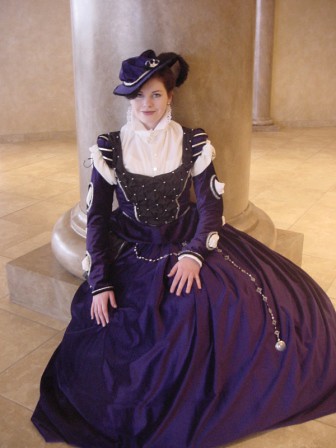
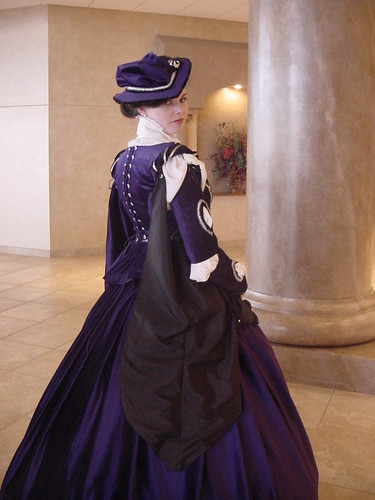
These garments will be in a very light, flowing fabric. The costumes will be much closer to the outfits of the time. The dresses will flow elegantly to the floor and cover them completely. Each woman will have her own color that depicts who she was as a person.

This image shows the style of dress well.
Sources Used:

The Bible: Genesis; http://bibleresources.bible.com/passagesearchresults.php?passage1=Genesis+3&version1=9 ; bibleresources.org ; 2010

Stage and Set

Artist's Rendition of a Medieval Pageant Wagon
The York Cycle was performed all throughout the town of York. The plays were set on pageant wagons which could move around the town to different places. "Every company had his pagiant, or parte, which pagiants weare a high scafolde with two rowmes, a higher and a lower, upon four wheeles" (Nagler, p49). The levels on the pageant wagons allowed them to have multiple areas of playing space. Plus, the usually had the area on the ground in front of the wagon. This allowed for different areas for Heaven, Eden and Earth.
The plays will be performed in the Tower Theatre, here on the Central Washington University campus. We decided against pageant wagons because we could build a more elaborate set for these set of plays. The set will consist of four levels; heaven at the top, then Eden, followed by Earth and finally Hell. (This could also be done with four different playing spaces). Each area just needs to be clearly designated and readable as said space. This would mean that when an angel speaks or God speaks it will be from the Heaven, while the people would be in their space. The devil would also be in hell but cross over to Eden when it turns into the serpent during The Fall of Man.
This I feel creates a nice contrast of the areas and spaces within the plays. Plus it also gives much opportunity for creativity in all areas of the backstage work; set design, lighting, props and sound.

Sources Used:
A Source Book in Theatrical History; A.M. Nagler; Dover Publications Inc; Mineola, N.Y; 1952

Tuesday, December 7, 2010

Medieval Music

Te Deum Laudamus
http://www.youtube.com/watch?v=sqwV9l-U8ds
Holy, Holy, Holy, Lord God of Hosts
http://www.youtube.com/watch?v=219JtSo_mI8
Angels' Song in The Judgment
http://www.youtube.com/watch?v=ctbR0KpOo0g

All of these songs were listed as being sung during the different plays. While there are no original scores to these songs that I could find I feel that these are great jumping off points of how the songs may sound for the feel we are going for. Even if the music is not used during the play for feel of it not needing to be there it can be used for preshow music. In the version of the script I found the stage directions are say things along the lines of, "Here He goes to the Seat of Judgment, with the singing of angels" (Cawley, p198). This is talking about Jesus going and sitting with angels singing around him. Now this can be used during the play if needed. It can also be done in two ways. Either having the actual people on stage singing or by using recordings such as these for the music. It would be done the same way in the plays that call for it.
On top of this there is also a need for preshow music. The preshow music will fit in with this music. Mostly it should just be instrumental with a possibility of some voices singing lightly.


Sources Used:
Everyman and Medieval Miracle Plays; A.C. Crawley; Guernsey Press Co.; London; 1990

The Judgment

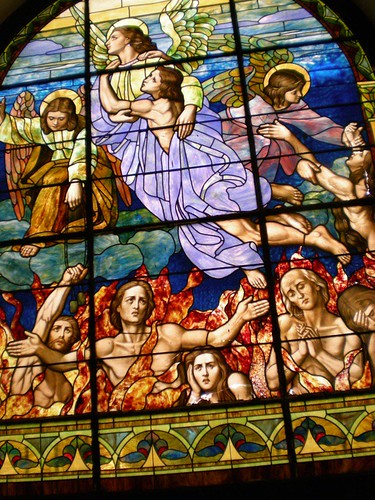
"Starting with the Creation and ending with the general Judgment, the medieval playwrights have dramatized the most significant scriptural events in which they believed God's purpose for mankind is revealed. Everything that has gone before has prepared us for the end, and so it is not surprising to find that the Judgment is full of echoes of earlier pageants. The Father of heaven has sent His Son to redeem Adam's race and to bridge the gulf between Himself and sinful mankind. On the day of doom those who have accepted Christ will be saved, and those who have rejected Him will be damned. This is the terrifyingly simple end of the long troubled story of man's relations with God" (Cawley, p 188). I feel that this sums up so well what The Judgment is all about.
Even back in the medieval times the creators of the York pageant made a way for 48 plays to come together in a large festival of theatre. It's a great feat and very well done. This play can be looked at as the big finale of all of these 48 plays and it even includes some singing of the Angels.

 
Sources Used:

Everyman and Medieval Miracle Plays; A.C. Crawley; Guernsey Press Co.; London; 1990

The Resurrection

The Resurrection was put on by the Carpenters. The carpenters seemed like a great choice for this specific play. Since Jesus' body rested in a tomb it seems fitting they would be chosen. This specific play would need the skills the carpenters possessed to successfully create this piece of art. The specific play is written in a rhyme scheme of aaabab.
Within the characters of this play are the three Marys. The first is Mary Magdalene. She was, " follower of Jesus, who cured her of evil spirits (Luke 8:2); she is also traditionally identified with the ‘sinner’ of Luke 7:37. Feast day, 22 July" (ORO, Mary Magdalene). She was known as a reformed prostitute and Jesus was known to have saved her during his lifetime. The second Mary was Mary, Mother of James. She, "had followed Jesus from Galilee, and watched from a distance, together with Mary, the mother of Jesus, and Mary of Magdala, when Jesus was crucified (Matthew 27:55-56). She was also among the women who went to the grave to anoint His body. According to John 19:25, she was a sister of Mary, Jesus' mother, and the wife of Cliopas" (Bible Prophecy, Mary (Mother of James and Joseph)). Finally there was Salome. "Salome’s name means peace. She was one of the women who were followers of Jesus, who cared for His needs in Galilee. She was devoted enough to stand with Mary Magdalene and Mary, the mother of James and Joses, as they watched from a distance as Jesus was crucified" (Chapman, Women of the Bible-Salome). I hope this information on these ladies of the bible can help the actresses find their characters.
So the story of the resurrection has a lot to do with these women going to the tomb where Jesus was buried, finding he wasn't there, being told by an angel that he has been resurrected and the sharing of that story with all.


Sources Used:

"Mary Magdalene, St"  The Oxford Dictionary of English (revised edition). Ed. Catherine Soanes and Angus Stevenson. Oxford University Press, 2005. Oxford Reference Online. Oxford University Press.  Central Washington University.  7 December 2010  http://www.oxfordreference.com/views/ENTRY.html?subview=Main&entry=t140.e46897

"Mary (Mother of James and Joseph)" AboutBibleProphecy.com;  7December 2010 http://www.aboutbibleprophecy.com/p44.htm

"Women of the Bible - Salome" Christian Living Site; Lynne Chaman; BellaOnline 2010; 7 December 2010 http://www.bellaonline.com/articles/art42876.asp

The Crucifixion

The Crucifixion was put on by the Pinners and Painters. "The Pinners, or pinmakers, who joined with the painters in producing this pageant, presumably made a grimly competent job of handling the 'hammers and nails large and long' used by the executioners" (Cawley, p143). The play was written with a rhyme scheme of ababababcdcd.
The Crucifixion is about the biblical story about how Jesus was crucified and saved people of their sins. The play mainly has the people who put him up on the cross talking with some longer speeches by Jesus. In the play they actually put Jesus up on a cross.

  " 27Then the soldiers of the governor took Jesus into the common hall, and gathered unto him the whole band of soldiers.
   28And they stripped him, and put on him a scarlet robe.
   29And when they had platted a crown of thorns, they put it upon his head, and a reed in his right hand: and they bowed the knee before him, and mocked him, saying, Hail, King of the Jews!
   30And they spit upon him, and took the reed, and smote him on the head.
   31And after that they had mocked him, they took the robe off from him, and put his own raiment on him, and led him away to crucify him.
   32And as they came out, they found a man of Cyrene, Simon by name: him they compelled to bear his cross.
   33And when they were come unto a place called Golgotha, that is to say, a place of a skull,
   34They gave him vinegar to drink mingled with gall: and when he had tasted thereof, he would not drink.
   35And they crucified him, and parted his garments, casting lots: that it might be fulfilled which was spoken by the prophet, They parted my garments among them, and upon my vesture did they cast lots.
   36And sitting down they watched him there;
   37And set up over his head his accusation written, THIS IS JESUS THE KING OF THE JEWS" (Bible, Matthew 27).

Putting in this verse from the bible will hopefully help the actors read part of the story of the Crucifixion of Jesus. There is a link to an online resource where they can read the rest of the story. This will hopefully give some perspective and meaning to the script which is written in verse. Also the script is shorter, so this will be the full story plus they can find the events which led up to the part shown in the script.


Sources Used:

Everyman and Medieval Miracle Plays; A.C. Crawley; Guernsey Press Co.; London; 1990

The Bible: Matthew 27; http://bibleresources.bible.com/passagesearchresults.php?passage1=Matthew+27&version1=9 ; bibleresources.org ; 2010

The Fall of Man

The Fall of Man was put on by the Coopers. The coopers were, "makers of casks and buckets" (Cawley, p17) and they were the ones who were assigned to this specific play. The rhyme scheme of this play is ababcbcdcdc with a dominate iambic rhythm.
Story of the fall of man is one many already known; even some who are not religious know of the story of how Adam and Eve got banished from Eden and sent to the world. "Adam's name comes from the Hebrew meaning “man” and perhaps from the Hebrew adamah, meaning “earth.” Adam named his partner Eve (Havvah), the “Mother of All Living Beings.” The name suggests a connection to the old Middle Eastern mother goddesses, who, like mother goddesses in much of the world, were often associated with trees and snakes. As is evident from the Genesis story, Eve had a close speaking relationship with the serpent (3:1–6)" (ORO, Adam and Eve).
The story of the fall of man is that the devil disguises himself as a serpent to tempt Eve to eat an apple from the tree of knowledge. Eve ends up eating the apple and then convinces Adam to do the same. They realize the greatness of their mistake and are overcome with guilt. They tell God of what they have done and so God banishes them from Eden. They now must live on Earth for be disobedient (ORO, Adam and Eve). 


Sources Used:
Everyman and Medieval Miracle Plays; A.C. Crawley; Guernsey Press Co.; London; 1990

"Adam and Eve"  The Oxford Companion to World mythology. David Leeming. Oxford University Press, 2004. Oxford Reference Online. Oxford University Press.  Central Washington University.  8 December 2010  <http://www.oxfordreference.com/views/ENTRY.html?subview=Main&entry=t208.e12>

The Creation of Adam and Eve

The Creation of Adam and Eve was put on by the Cardmakers. "The cardmakers, to whom the third York pageant belonged, were a guild of craftsmen who made cards for combing wool. They are one of several representatives of the woollen industry associated with pageants in the York cycle..." (Cawley, p11). These pageants were a great way for people to advertise their goods while doing something fun and entertaining.
This play is about when God created Adam and Eve. First he created Adam and then took a rib from Adam to create Eve. They were allowed to live in Eden, or Paradise, and could have whatever they wanted. They just could not eat the apples from the Tree of Knowledge. It was forbidden to them.

This is a link to a scholarly article on Adam and Eve. It's entitled Adam and Eve as Historical People, and Why It Matters by John C. Collins. This article gives a look into the story of Adam and Eve. It provides a new way of looking at these two. I feel like this can really be beneficial to the actors who will play Adam and Eve.

http://web.ebscohost.com.ezp.lib.cwu.edu/ehost/detail?vid=3&hid=111&sid=a7b0b3ad-88d5-41f9-a860-a861194dad6c%40sessionmgr110&bdata=JnNpdGU9ZWhvc3QtbGl2ZQ%3d%3d#db=a9h&AN=52810367

Sources Used:

Everyman and Medieval Miracle Plays; A.C. Crawley; Guernsey Press Co.; London; 1990

The Creation, and the Fall of Lucifer

The Creation, and the Fall of Lucifer was put on by the Barkers company. A barker was a, "character of the fairground or itinerant theatre company, who stood at the door of the booth and by his vociferous and spellbinding patter induced the audience to enter" (ORO, barker). It makes sense for this specific company to have the first show of the grouping because they could draw an audience in and get them ready for the rest of the shows that were to come.
This play is about what you would expect, the creation and fall of Lucifer. The play is written in alliterative verse with a rhyme-scheme ababcddc and sometimes ababcccc. Lucifer is also known as the devil. So this play is all about how the devil came to be. Lucifer was, "the rebel archangel whose fall from heaven was supposed to be referred to in Isaiah 14:12; Lucifer was traditionally interpreted as the name of Satan before his fall" (ORO, Lucifer). The story is basically that of, "the pride of Lucifer, the first of the angels, and his wish to equal God. Lucifer and his followers were then expelled from the celestial paradise and condemned, for their greater suffering, to dwell eternally on earth and in the infernal depths" (ORO, demon). So overall, this play is the beginning, when God started created his first angels and then the banishment of those who turned evil. Thus, creating the devil and hell.


Sources Used:
"Barker"  The Concise Oxford Companion to the Theatre. Ed. Phyllis Hartnoll and Peter Found. Oxford University Press, 1996. Oxford Reference Online. Oxford University Press.  Central Washington University.  7 December 2010  http://www.oxfordreference.com/views/ENTRY.html?subview=Main&entry=t79.e223

"Lucifer"  A Dictionary of Phrase and Fable. Edited by Elizabeth Knowles. Oxford University Press, 2006. Oxford Reference Online. Oxford University Press.  Central Washington University.  7 December 2010  http://www.oxfordreference.com/views/ENTRY.html?subview=Main&entry=t214.e4206

Jérôme Baschet, Irène Sorlin "demon, demonology"  Encyclopedia of the Middle Ages. Ed. André Vauchez. © 2001 by James Clarke & Co. Encyclopedia of the Middle Ages (e-reference edition). Distributed by Oxford University Press.  Central Washington University.  7 December 2010  <http://www.oxfordreference.com/views/ENTRY.html?subview=Main&entry=t179.e804-s1>

The York Cycle

I have chosen to do six plays from the York Cycle. The York Cycle was a grouping of 48 short plays that were all biblical stories. Each play would be performed on a moving pageant cart that was owned by one company. The companies usually consisted of the cardmakers or the coopers; some sort of workers from the city. (Brockett, p86-87)
When these would be performed they would travel all around the city of York. There would be marked destinations for the plays to be performed and they would move like a parade. This was to make sure that the most amounts of people could see these biblical stories brought to life. So it helped the church get the stories and teachings of the Lord out to the general public.
The York Cycle was named because this certain set of plays was performed in the city of York. This was a town in Europe that was a fairly large city for back then. P.J.P. Goldberg writes in Women, Work, and Life Cycle in a Medieval Economy that, "York was both a provincial capital, on occasion even the seat of royal government, and, since the seventh century, the centre of an ecclesiastical province" (Goldberg, p1). Goldberg continues to talk throughout this book about York and its state of economy and the journey it took throughout the years. The pageant plays would have been a great escape for people and a wonderful source of entertainment.
The plays I have chosen from this cycle are:
1. The Creation, and the Fall of Lucifer
2. The Creation of Adam and Eve
3. The Fall of Man
4. The Crucifixion
5. The Resurrection
6. The Judgment


This is a map of York (Goldberg, p41)

Sources Used:

History of Theatre: Foundation Edition; Oscar G. Brockett and Franklin J. Hildy; Pearson Education Inc.; Boston, MA; 2007

Women, Work, and Life Cycle in a Medieval Economy: Women in York and Yorkshire c.1300-1520; P.J.P. Goldberg; Oxford: Clarendon Press; New York: Oxford University Press, 1992